
About the Authors
The Life of Hercat
Mar
R. D. Chater, who performed and published under the name Hercat—an anagram of his surname—was a British conjurer, illusionist, ventriloquist, and writer whose career bridged stage performance and popular magic literature at the turn of the twentieth century.
Born in 1843 into a naval family, Chater grew up in a household shaped by discipline and an expectation of service. He went to sea at an early age, and it was during this period, while still immersed in naval life, that he later recalled receiving his first practical instruction in magic. These early experiences appear to have sparked an interest that would remain with him long after his naval career ended.
Invalided out of the service in his early twenties, Chater did not immediately pursue a career in magic. Instead, he worked as a journalist—and for a time also as an actor—turning to professional conjuring only later in life, probably in the late 1860s. He enjoyed a period of successful performance in America before returning to England, experience that later underpinned his habit of billing himself as an American entertainer.
By the late nineteenth century, Hercat was appearing publicly in London, notably at Dean Street, at the corner of Oxford Street, where he presented entertainments under the title The Gallery of Mystery. He styled himself an “Eminent American Illusionist, Ventriloquist and Humorist”—a description repeated by his manager, William Morton of the Greenwich Theatre, who in 1888 managed the copyright of Hercat’s illusions and oversaw his British tour the following year. Contemporary observers, however, were quick to note that despite this billing, Hercat was unmistakably English.
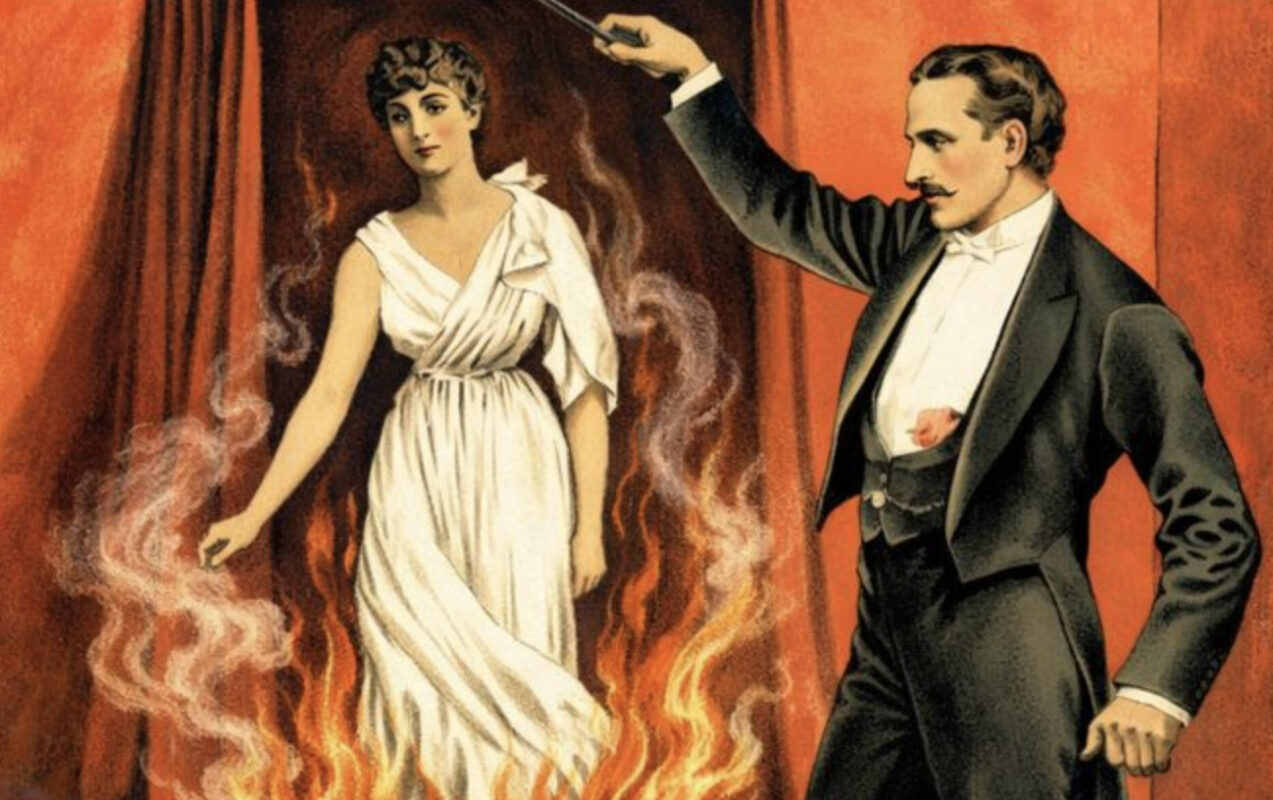
As a stage performer, Hercat was not regarded as a great inventor. Nevertheless, he did originate certain effects and achieved notable success with his illusion She, a cremation illusion that enjoyed a long and favourable run before the public and was featured at the Egyptian Hall in 1888. Another illusion, The Blue Room, appeared in his repertoire in the mid-1890s. His performances combined illusion, ventriloquism, and comedy—the wide-ranging stock-in-trade of popular entertainers of the era. Writing in 1957, Stanley Collins recalled him as an unimpressive performer, a reminder that his reputation rested more securely on his publications than on his stagecraft.
Hercat’s lasting importance lies above all in his books. Among the first magicians to issue such works aimed deliberately at the general public rather than a closed professional fraternity, he established a practical, instructional tone beginning with Card Tricks and Conjuring Up-to-Date (1896). This material was repeatedly reworked, expanded, and reorganised in later volumes—notably Conjuring Up-to-Date and Card Tricks With and Without Apparatus—reflecting both the popularity of the original work and his willingness to repackage existing material for new audiences.
Later publications, including Latest Sleights, Illusions, Mind Reading and New Card Effects (1903), Ventriloquist and Ventriloquial Dialogues (1905), and Chapeaugraphy, Shadowgraphy and Paper-Folding (1909), brought together card magic, sleight-of-hand, ventriloquism, novelty arts, and contemporary amusements in accessible handbooks. In 1912, he issued Simple Tricks for Social Occasions, also published the same year under the title More Conjuring—identical content, different packaging. This volume ranged widely beyond cards and coins to include handkerchief tricks, ring effects, candle experiments, arithmetical problems, match puzzles, and other forms of informal entertainment, and openly acknowledged the contribution of his friend F. Walford Perry.
Hercat was candid about his motives as an author. He did not claim to be breaking new ground. By the end of the nineteenth century, exposure of magical methods was already widespread in magazines and periodicals, and professional secrecy had been substantially eroded. His aim was therefore organisation rather than revelation: to gather, systematise, and present material in a clear and usable form. His books offered structured instruction rather than innovation and were long recommended to younger readers and aspiring performers.
By the years preceding his death in 1913, Hercat was in failing health. His writings, however, continued to be valued for their practical instruction and anecdotal insight. Today they remain an instructive record of late-Victorian conjuring, and of a performer who helped shape magic’s transition from guarded craft to popular literature.
